

If you were to ask me what is the ONE skill Algebra students struggle with most, I wouldn’t hesitate:
👉 Factoring.
Hands down.
And honestly? When my Calculus students struggle, it almost always traces back to gaps in Algebra… and yes—factoring is usually the culprit.
So if your students are struggling, you are definitely not alone.
Here are the strategies I’ve found to be the most effective in the classroom 👇
1. Always Start with the GCF
Before doing anything else:
👉 Check for a Greatest Common Factor (GCF)
This step is often skipped—and it makes everything harder if students ignore it.
Why it matters:
- Simplifies the expression
- Makes factoring more manageable
- Prevents unnecessary mistakes later
💡 Teacher Tip: Train students to automatically ask:
“Can I factor anything out first?”
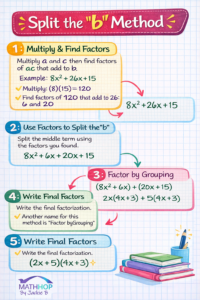
2. Split the “b” Method (a.k.a. Factoring by Grouping)
This is one of the most reliable methods—especially because it builds directly off what students already know when a=1.
Steps:
- Identify a, b, and c.
- Multiply a x c
- Find two numbers:
- Multiply to ac
- Add to b
- Rewrite the middle term:

- Factor by grouping
💡 Tips for Teaching This Method
✔ Signs Matter
- If ac is positive → same signs as b
- If ac is negative → opposite signs
✔ Order Doesn’t Matter
- mx + nx or nx + mx both work
✔ Don’t Skip the GCF
- Always check first!
Visual: Split the “b” Method
3. The “Rainbow & Divide” Method (Student-Friendly Alternative)
This is a strategy I use when students are still not getting it.
And honestly—it can be a game changer for certain learners.
Why This Method Works
When a  , students can’t just factor c anymore.
So instead:
👉 Multiply a x c
👉 Find factors of that product
👉 Then fix it at the end
How I Teach It
I tell students:
“Draw a rainbow from a to c” 🌈

Then:
- Multiply a x c
- Find factors that add to b
- Factor like normal
- Divide out the a at the end
⚠️ Common Student Mistakes
- Forgetting to divide out the a
- Dividing incorrectly
- Trying to factor using c instead of ac
💡 Teacher Tip
I always tell students: “If you use this method, you MUST check by multiplying.”
Visual: Rainbow & Divide Method

4. Area Model Method
This is a fantastic visual strategy for students who struggle with abstract steps.
Steps:
- Identify a, b, and c
- Multiply a x c
- Find factors that multiply to ac and add to b
- Draw a 2×2 box
· Top Left: ax2
· Bottom Right: constant “c” term
- Fill in the remaining boxes with your two factor terms & an “x” attached
- Find GCFs across rows and columns
- Write the factors
Why Students Like This Method
- Very visual
- Organized
- Reduces guesswork
Visual: Area Model

Final Thoughts
There is no one “perfect” method for factoring.
Some students will love:
- Split the “b”
Others will prefer:
- Rainbow & Divide
- Area Model
👉 The key is to give students multiple entry points so they can find what works for them.
Want to Make Factoring More Engaging?
If your students are tired of worksheets (and let’s be honest… they are), I use:
✔ Digital escape rooms
✔ Self-checking activities
✔ Interactive practice
These make a huge difference in both engagement and retention. Here is a self-checking factoring activity that my students love!
