

My students will tell you that I can make ANY topic about math, but Earth Day is one of those perfect teaching opportunities. Students are already familiar with it, it feels timely, and it naturally connects to real-world problem solving. The best part? You do not need to pause your curriculum or spend hours prepping a themed unit to make it meaningful.
In fact, so much of what we track about the environment already involves math—data, percentages, graphs, rates, comparisons, budgeting, measurement, and modeling. That means Earth Day can fit right into the standards you’re already teaching.
If you’re looking for low-prep ways to celebrate Earth Day in your middle school math classroom, here are easy strategies you can use right away.
1. Use Real Environmental Data for Warm-Ups
Instead of your normal bellringer, swap in a quick Earth Day data prompt.
Examples:
- A household recycles 18 pounds of paper each month. How much in a year?
- If a reusable bottle saves 3 plastic bottles per week, how many in 12 weeks?
- Global temperatures rose by ___ degrees over time. What is the average rate of change?
- A school (I always use the name of the school I’m teaching at) reduced electricity use by 12%. If they used 5,000 kWh before, how much now?
These take almost no prep—just turn your normal math question into an environmental context.
Why it works: Students still practice core skills, but the math feels relevant.
2. Graph Real-World Trends
Earth Day is a natural fit for graphing and statistics.
Students can analyze:
- Recycling rates over time
- Carbon emissions by country
- Water usage by household activity
- Waste produced by different materials
- Temperature trends across decades
Ask students:
- What trends do you notice?
- Is the data increasing or decreasing?
- Are there any outliers?
- What prediction could you make for the future?
Many public organizations publish free datasets teachers can use, including government and education sites.
3. Turn Ratios, Rates, and Percents Into Sustainability Problems
If you teach proportional reasoning, Earth Day gives you endless real-life examples.
Try prompts like:
- If 8 out of 20 students bring reusable water bottles, what percent is that?
- A family reduces trash from 15 pounds to 9 pounds. What is the percent decrease?
- A bike ride avoids 2 pounds of CO₂. How many pounds are avoided after 6 rides?
- If one tree absorbs a certain amount each year, how many would 12 trees absorb?
Students often engage more when they can picture the scenario.
4. Use a Quick Classroom Data Investigation
Want something interactive? Let students collect their own data.
Ideas:
- Survey how students get to school
- Count reusable vs disposable lunch containers
- Estimate daily classroom paper use
- Track lights/devices left on unnecessarily
- Measure waste collected during lunch
Then use the data to:
- Create graphs
- Find mean, median, mode, range
- Compare groups
- Write conclusions
- Suggest improvements
This turns math into a real problem-solving experience.
5. Build an Earth Day Challenge Station Rotation
Need something more engaging than a worksheet? Set up 4–5 mini stations with short tasks.
Example stations:
- Solve percent decrease recycling problems
- Interpret a graph about emissions
- Compare unit rates for transportation choices
- Calculate area for a community garden design
- Analyze a survey dataset
Students rotate, collaborate, and stay active while practicing skills.
6. Connect Math to Everyday Choices
Students love it when math answers real questions.
Ask:
- Is it cheaper to use reusable bags over time? This really interests students in states like Colorado where we have to pay for bags (plastic or paper) at stores.
- How much water could be saved by shorter showers?
- Is walking or biking faster for short trips?
- How much paper could our class save in a month?
- What’s the better buy: refillable bottle or disposable packs?
This kind of math reasoning builds decision-making skills—not just computation.
7. Keep It Simple: Add the Theme, Keep the Standards
You do not need a giant Earth Day project for it to be worthwhile.
Sometimes the easiest shift is the best one:
- Change names in word problems
- Use environmental numbers in examples
- Replace random graphs with meaningful ones
- Let students discuss solutions after solving
- Use one themed activity for the day
Even a small change can boost engagement.
Why Earth Day Math Lessons Matter
Students sometimes ask, “When will I ever use this?” Earth Day gives you an immediate answer.
Math helps us understand patterns, compare choices, solve problems, and make smarter decisions. Whether it’s analyzing waste, budgeting energy use, or interpreting climate data, math is part of understanding the world around us.
And that makes your lesson more than seasonal—it makes it meaningful.
Want a Ready-to-Go Earth Day Math Activity?
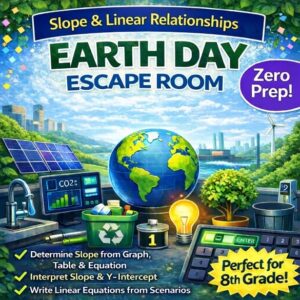
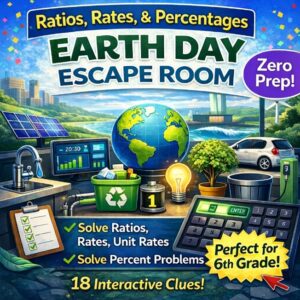
If you’d rather skip the prep and give students a highly engaging review activity, I’ve created Earth Day-themed digital escape rooms for middle school math.
They’re designed to review key standards through problem solving, teamwork, and interactive clues—while still keeping the Earth Day theme students enjoy.
Perfect for:
- 7th Grade Math
- 8th Grade Math
- End of Unit Review
- Test Prep
- Seasonal Engagement Days
- No Prep Sub Plans
If you want a fun way to celebrate Earth Day and keep the math rigorous, they’re a great fit for April.
Whatever you decide to do, Earth day is ripe for incorporating math and making lessons memorable for students. Happy Teaching, summer is right around the corner!