

The first week of school is always a balancing act.
On one hand, you need to know what your students actually remember from last year. Can they solve equations? Work with exponents? Interpret a graph?
On the other hand, you want to build a positive classroom culture—not hand students a packet that feels like a high-stakes test before they’ve even found their seats.
If you’ve ever watched students shut down during a traditional diagnostic assessment, you’re not alone.
The good news? You can gather meaningful data about students’ prerequisite skills without giving a stressful paper test.
In fact, some of the most revealing assessments don’t look like tests at all.
This post shares five engaging, low-pressure ways to assess prerequisite skills while building confidence and setting the tone for a productive year.

Why Traditional Diagnostic Tests Often Miss the Mark
Paper diagnostics seem efficient, but they come with a few major drawbacks:
- They can trigger anxiety, especially for students who struggled in math previously.
- Students often rush or give up, leading to inaccurate data.
- They send the message that math is about being tested rather than explored.
- They provide little insight into students’ reasoning and problem-solving habits.
A student who freezes on a 25-question diagnostic may know much more than the score suggests.
That’s why I prefer assessment strategies that feel more like learning experiences than tests.
1. Use Gamified Review Activities
Gamification lowers the emotional stakes and increases engagement.
When students work through a digital escape room or self-checking activity, they receive immediate feedback and can retry until they’re successful. Instead of focusing on a grade, they focus on solving the next challenge.
This gives you valuable information:
- Which students persist through mistakes
- Which concepts cause the most trouble
- Who needs support before grade-level instruction begins
Why It Works
Students are far more willing to take risks when the activity feels like a game rather than a test. They may not even realize they’re being assessed.
Skills You Can Assess
- Solving equations
- Working with exponents
- Operations with polynomials
- Inequalities
- Factoring
- Graph interpretation
2. Gather Observation-Based Data with Stations
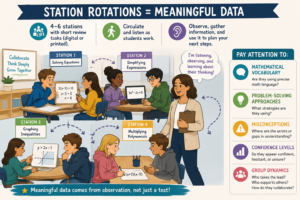
Station rotations are one of the best ways to assess prerequisite skills while students collaborate.
Set up 4–6 stations with short review tasks, either digital or printed.
As students work, circulate and listen.
Pay attention to:
- Mathematical vocabulary
- Problem-solving approaches
- Misconceptions
- Confidence levels
- Group dynamics
Often, what students say is more informative than what they write.
Questions to Ask While Circulating
- “How did you decide to start?”
- “Can you explain your reasoning?”
- “What does this answer represent?”
- “How do you know your answer makes sense?”
3. Use Error Analysis Activities
Instead of asking students to solve a problem from scratch, present a common mistake and ask them to diagnose it.
For example:
A student simplifies  as
as  . What mistake did they make? What is this student’s misunderstanding?
Or:
A student distributes incorrectly when multiplying binomials. Where did their reasoning break down?
Why Error Analysis Is So Powerful
Students must:
- Understand the concept
- Identify the misconception
- Explain correct reasoning
This reveals depth of understanding much more effectively than a multiple-choice question.
4. Create Collaborative “Triage” Groups
Group students intentionally and give them a short review challenge.
Then observe:
- Who takes the lead
- Who explains clearly
- Who asks good questions
- Who depends heavily on others
This strategy helps you assess both content knowledge and collaboration skills.
It also gives students a chance to support one another before formal instruction begins.
5. Use Digital Escape Rooms and Self-Checking Activities for Instant Feedback
This is one of my favorite back-to-school assessment strategies.
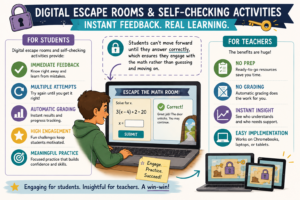
Digital escape rooms and self-checking activities provide:
- Immediate feedback
- Multiple attempts
- Automatic grading
- High engagement
- Meaningful practice
Students can’t move forward until they answer correctly, which ensures they engage with the math rather than guessing and moving on.
For teachers, the benefits are huge:
- No prep
- No grading
- Instant insight into student readiness
- Easy implementation on Chromebooks, laptops, or tablets
Ready-to-Go Activities for the First Week of School
If you want a low-stress way to assess prerequisite skills, these resources are designed specifically for the beginning of the year.
Algebra 1 Prep Digital Escape Room
Review critical pre-Algebra skills while students solve clues in a fun, self-checking format.
Algebra 1 Prep Back-to-School Digital Escape Room
Algebra 2 Prep Digital Escape Room
Assess Algebra 1 skills needed for success in Algebra 2.
Algebra 2 Prep Back-to-School Digital Escape Room
Self-Checking Digital Activities
- Properties of Exponents Digital Activity
- Multiplying Binomials Digital Activity
- Solving Multi-Step Linear Inequalities Digital Activity
These activities are perfect when you want students practicing and reviewing while you collect meaningful data.
What to Look For During These Activities
Regardless of which strategy you use, focus on these key indicators:
Mathematical Skills
- Accuracy
- Efficiency
- Conceptual understanding
Productive Habits
- Persistence
- Willingness to ask questions
- Ability to explain reasoning
Collaboration Skills
- Communication
- Leadership
- Listening
These observations will help you make informed decisions about pacing, grouping, and intervention.
Final Thoughts
The first week of school should build confidence—not reinforce the idea that math is about failing a test.
By using low-stakes, engaging assessments, you can gather the information you need while helping students experience early success.
Whether you use stations, error analysis, collaborative challenges, or digital escape rooms, you’ll gain a clearer picture of your students’ readiness and set a positive tone for the year.
Try One New Assessment Strategy This Year
If you’re looking for a simple place to start, choose one non-traditional assessment strategy and try it during the first week.
You may be surprised by how much more your students reveal when the assessment feels like learning rather than testing.
And if you’d like ready-to-go resources that combine review, engagement, and instant feedback, my digital escape rooms and self-checking activities are designed to do exactly that.